
A Study in Starlight—Chapter Twenty-nine
Continuing this serialised novel, in which Holmes and Watson find themselves very far indeed from Victorian/Edwardian London

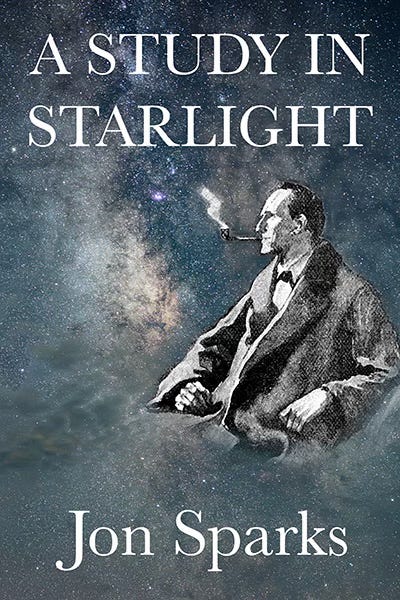
Watson
“My name is Sherlock Holmes. The year is 1902.” The camera panned as he continued, “Look around me and you see the sitting-room of Number 221B Baker Street, London, as it was in the early spring of that year.”
He smiled, that familiar thin-lipped half-smile. “Of course this is a simulation. We are not in London at all; we are in fact on an Orbiter above the planet Trevallan, twenty-four light years from Earth. And I am equally aware that the year is not 1902 but 2236. Nonetheless, you see me, and this room, as they were then, and if you move to the window you may see a glimpse of Baker Street and the life of London.” The camera obeyed his bidding and presented the same street view I’d seen so soon after my first rousal.
A little too similar, in fact. It might be eight years ago—and that, at least, was real time—but my memories of that moment were clear. Surely that was the same scurrying messenger-boy, the same lady in the same blue velveteen walking-suit. Ah well, I sighed to myself, This time you know it isn’t real.
It was unreal, to be sure, but it was as clear and vivid as could be. Something in that view tugged at me. Something about it still said Home.
I was glad when the camera swung back to Holmes, and he picked up his cue like a trained actor. “Everything you see around me is a simulation, yes, but I am not. There will, I know, be differing opinions on how best to describe what I am, but this much, at least, is clear: I am a living, breathing, flesh-and-blood individual. And my name is Sherlock Holmes.”
He paused there, as the script required. A linking segment would be inserted in editing, allowing viewers to choose from several options. One would be to take a tour of 221B and a walk down Baker Street with Holmes as guide. Another would be to switch to the interview which would be recorded later.
Mary and I looked at each other, both nodding. “That was fine, Sherlock,” said she. “You dory to go straight on with the room tour?”
“By all means, madam.” He didn’t blink at ‘dory’; even on the first day he’d shown facility in deducing the meaning of her Redder expressions.
“I’ll count you in. Three… two… one…”
We’d had considerable discussion about who should conduct the interview and where it should be set. Using the Baker Street simula had been one obvious option, but we’d thought it might be too much ‘home turf’ for him, too alien for anyone else. A contemporary station setting might have veered too far the other way. Neutral ground meant somewhere that neither would feel entirely at home. Splitting the difference in time suggested 2069, but it turned out interior design of that time had been dominated by ‘biomimetic’ styles, creating wildly organic forms and surfaces that felt more like a fantasy forest glade than a comfortable interior.
It had been Aurel who said, “The blander, the better, vrai? You don’t wanna distract. Directorware’ll prob’ly shoot mostly tight heads anyway.” With that thought, and the need for both interlocutor and interviewee to feel comfortable, we’d agreed on simple armchairs that probably wouldn’t have looked out of place in any century from the 20th onward, and a backdrop that graduated from green to blue in an unfocused nod to Terran land and sky.
Surprisingly, the question of who the interviewer should be proved be easier to solve. It couldn’t be Robin, who was due to face a similar interview vemself, and it couldn’t be me. Self-evidently, we were far too close, each in our own way, to represent the curiosity and scepticism that would be the dominant feelings among audiences on Earth, Mars and elsewhere. In fact, we swiftly agreed that it should not be anyone who’d had significant dealings with Holmes at any time during his still-brief spells of Incarnate life.
“What about Eri?” said I at that point. Mary’s response was immediate and enthusiastic. I knew she rated her deputy’s intelligence highly. Robin thought just a moment before saying, “Yes, why not? She’s never met him, has she?”
It was only when the two were seated facing each other that I began to entertain a few doubts. We’d tried to create a setting in which both would feel comfortable. I hadn’t really stopped to consider whether Holmes would feel comfortable with Eri. I suddenly recalled my first encounter with her, a week or so into my time on Trevallan. By then I had begun to grow accustomed to women wearing what I’d initially seen as male clothing, to bald women. All those things, and more, had begun to seem almost normal. And there were other people with tattoos about, including some with facial markings. But Eri’s, densely covering both face and scalp, were something else again. At our first encounter, it had taken all my self-control not to stare—or maybe, if I am entirely honest, not to stare too blatantly. It was a measure of how much had changed in eight years that I barely noticed them now, could see past them to her vivid range of expression.
It was different for Holmes, not least because it hadn’t been eight years for him. Subjectively it was still only a few weeks. Still, at the moment, he didn’t seem too disconcerted. I hoped that meant he was focusing on the substance of her questions.
She began by introducing herself for the camera. “Kia Ora. My name is Erenora Katu. I’m Deputy Head of Operations on Trevallan Orbiter and I’m here today talking to… well, would you like to introduce yourself?”
“My name is Sherlock Holmes,” said he with that same half-smile.
“Well, that’s kind of the question we’re here to discuss. Let me put it like this: are you the real Sherlock Holmes?”
“I am real. I’m not a simula or hologram or projection or whatever else you call such things. You can verify for yourself that I am a solid, living, breathing, man.”
“Let’s take that as read, shall we? Plenty of people here have vouched for you being real.”
“As you wish, madam.” I had to smile to myself, first at his addressing Eri as ‘madam’, then at the way she blinked before hastily composing herself. “I am real, and my name is Sherlock Holmes. Is that a sufficient answer to your original question?” I could not have said how his face changed, so minute was the alteration, yet I could see the irony. Doubtless only one who knew him as well as I did—or had—would be aware of it.
“It’s a perfectly accurate answer,” said Eri, “But I don’t know about ‘sufficient’.”
“Well,” said Holmes, “The word you stressed in your question was ‘real’. That word can be used in many different senses. Perhaps I should ask you which you had in mind?”
Eri, unruffled, nodded slightly. “I think at this point… I’m sure everyone taking this ‘cast is familiar with compiling. But whole-body human compiling has been proscribed for half a century, everywhere in the Home System except possibly Callisto. I’m guessing a lot of people don’t know ‘xactly how it works.
She ran through a brief account of the background, finishing with, “Myself, I was vived thirteen years ago. At that moment, I was identical, to the molecular level, with my original back on Earth.”
Just for a moment, she faltered, glanced over at us. At Mary, I thought. It wasn’t my approval she was seeking. Mary gave her a swift thumbs-up. “She’s frettin’ she’s goin on too long,” she whispered to me. “But it all needs sayin. Might reshuffle some of it, but…”
I’d missed Eri’s resumption, but it was easy enough to interpolate. “…was sixty-four years ago. My original back on Earth is ninety-six years old now. I didn’t even know if she was still alive until the Rangitīkei got here. And if she’s watching this now… it’s probably even weirder for her than it is for me thinking about it.
“Well, the point of all this is: I am Erenora Katu, born in 2138 in Taupō, Aotearoa, also called New Zealand. But so is my original. For thirty-two years we were one person. Since then, she’s had another sixty-four years of life. I’ve only had thirteen, but in very different circumstances. We’re no longer the same person, but we still share the same name, date of birth, same genome. So here’s a question for you, Sherlock Holmes, and for everyone else following: which is the real Erenora Katu?”
Holmes sat back a little, folding his arms. “A fascinating question. Quite different from the one you asked me, but it may shed some light.”
“And how would you answer it?”
He pressed his lips together; already thin, they all but disappeared entirely. “You are,” said he. He paused a moment, indulging his theatrical streak, before adding, “And so is she. There may be some, perhaps particularly those who argue from a religious perspective, who might maintain that only the original is ‘real’, but from my standpoint—which I might, for clarity, describe as Anglican-agnostic—such arguments are pure sophistry.”
I glanced at Mary, and knew she was wondering the same as me: what would Captain El Khatib think of this? He, like everyone else, would have the chance to see the complete recording as soon as essential edits had been completed.
“Thank you,” said Eri, smiling for the first time. “Well, so much for me. And the same goes for everyone else whose dataset was brought on the seedship. But not for you… would you like to explain it, or should I?”
“I’m sure you are much better equipped to do so.”
Eri gave a concise and accurate recapitulation of how Holmes (and I) had come to be. “So,” said she finally. “You are a recreation of a fictional character. Is that a fair summary?”
“It is fair as far as it goes,” said Holmes. “But… whatever else I may be, I am not a fictional character. As we have already established, I am quite real. And, that being so, may we lay to rest your opening question? You asked: are you the real Sherlock Holmes? I submit there can only be one answer.”
“Yeah, nah.” I’d known Eri long enough to know that indicated acknowledgement of what he’d said, not necessarily agreement. Mary, catching my look, smiled, gave a slight shrug. Eri was not a professional at this; no one on Trevallan was. If a little Aotearoan vernacular perfused her speech now and then, it was, as Mary would say, nil fret.
“So, tell us, then… who is Sherlock Holmes?”
“Salient points? Anyone who wishes to know more is free to peruse any or all of the stories generally attributed to one Arthur Conan Doyle, although in my frame of reference, as I believe you call it, they were written by my good friend and companion in many escapades, Doctor John Watson.” Holmes gave the briefest glance in my direction. “Who is sitting there, just a few yards—metres, I beg your pardon—away.”
Damn you, Holmes. I’d hoped to stay out of this, but at least one camera would be seeking me out now. I tried to keep my face decently unruffled, knowing better than to attempt a smile. Forced smiles only ever look one way: forced. A discreet squeeze of the hand from Mary was some comfort.
Meanwhile Eri was agreeing that, yes, salient points would be fine. “Very well,” said Holmes. “I was born in the year 1854. For context, 1854 is seventeen years into the reign of Queen Victoria—Victoria the First, as I believe she is now known—and virtually all of my career lay within the Victorian era.”
He paused a moment, pensive. “I believe I must qualify that statement somewhat. Virtually all of my career that I remember lay within Victoria’s reign. She died in 1901; my memories end in 1902. It occurs to me, just now, that there is a parallel, of sorts, with your own situation, and that of, I suppose, everyone else here. You mentioned, I recall, that after deepscanning, your original has enjoyed—let us hope that ‘enjoyed’ is appropriate here—another sixty-four years of life. Whereas you yourself have lived only another thirteen, and, as you say, under very different circumstances.”
“Achcha,” said Eri. Not ‘Kiwi’ slang, still less authentic Māori; the word was Hindi—and, I recalled, also Urdu. I’d used it myself often enough, during my time in India and beyond the North-West Frontier—or so my memories told me.
“There are a few Sherlock Holmes stories dated after 1902. The latest of them dates to 1914. So there is a sense in which there is a version of me with a divergent… I believe timeline is the word?”
“Sureas.”
“Just as you and your original have occupied different timelines since a certain moment in 2269… Well, the parallel is inexact, so I shall not labour it.”
He smiled. “I believe this digression began when I spoke about my career overlapping with Victoria’s reign. And the salient points you were seeking from me really concern that same career. I was studying the art of detection from an early age, and began attempting to refine it even as I took on my first cases as an amateur. The earliest for which there is any sort of record would be when I was twenty or twenty-one, the record being from my retelling of it to Watson some years later. My first meeting with the good doctor did not come until 1881. By that time I was beginning to establish myself as a consulting detective—the world’s first, to the best of my knowledge.
“A few years later Watson published his account of that meeting, and the first case in which he accompanied me. For a number of years after that we shared rooms in Baker Street; I have already helped to record what I believe is called a virtual tour of those rooms, which have been recreated in the simula studio here. Recreated with remarkable fidelity, if I may say so.”
“Though aren’t you saying there… the rooms match your memories, but then weren’t they created from the same source material as your memories?”
Holmes waved a thin hand. “I suggest you ask Robin Francis about that… I’d like to say a little more about John Watson, if I may.”
“Achcha.”
“I fear I have rebuked him many times for focusing on the more sensational cases, or sensational aspects of cases, rather than what always fascinated me: solving the intellectual puzzle. I think I said to him once, In general the more bizarre a case appears, the less mysterious it proves to be. It is the commonplace, featureless crimes which are truly puzzling. Or words very much to that effect. I was inclined, too often, to mock, or at least to belittle, his literary efforts. I must, however, acknowledge that he was, beyond doubt, a better judge than I of what would attract and retain readers; and that the stories did much to spread my name and reputation, and therefore to attract to me a greater number and wider variety of cases than I would otherwise have enjoyed.”
I stretched up to whisper in Mary’s ear. “What the deuce?”
“Seems cheery to me.”
“But why now?”
I didn’t have time to ponder the question, as Eri was saying, “…going to ask if you’d read any of the stories, but I guess you just answered that.” Holmes inclined his head. “But have you read any of the ones from after 1902?”
“I think that would feel highly… uncomfortable. You must face somewhat similar tension when receiving news of your counterparts… your originals, I should say.”
“Achcha.” She shrugged. “I guess all of us have had the conversation some time: would we ever want to meet our originals, or even get direct missives from them? Lot of us are having them all over again, now it’s no longer purely hypothetical.”
“And I suppose there is nothing to stop an original travelling here…”
Eri looked startled. “I guess not… We’ve always talked in terms of going back to the Home System… But we’re meant to be talking about you. You said you were the world’s first ‘consulting detective’.”
“To the best of my knowledge, yes.”
“What’s special about you that you could do that?”
Holmes shrugged. “In many ways, simply the fact that I was the first. Which means that I originated the notion and developed the practice. Or, in another frame of reference, that Arthur Conan Doyle did. But if I may speak from my own frame of reference…?”
“I think that’s what we’re here for.”
“Thank you. In that case, then, the qualities which I think enabled me to achieve some measure of success in my profession… I think in fact it would be fair to call it a vocation; the primary qualities I needed were a highly developed faculty of analytical reasoning, and the ability to close one’s mind to all distractions. As I once said, ‘It is of the highest importance in the art of detection to be able to recognise, out of a number of facts, which are incidental and which are vital.’ To these essentials are added the more mundane yet still invaluable qualities such as the ability to recognise a broad range of, for example, soil types or varieties of tobacco ash, both of which furnished significant clues on several occasions.” He smiled briefly. “Though I understand that tobacco ash, at least, would now be a very rare thing to encounter. Alas.”
Eri looked a little startled at the ‘alas’, but went on quickly, “Anything else?”
“Perhaps the facility for disguising my appearance so that I might pass unremarked in almost any milieu. Again, I am not yet sure how such an ability might translate into the present century. But above all I believe what set me apart and gave me a distinct advantage over the general run of police-detectives—I speak here only of the police-detectives of the Victorian era, I hasten to add—was my conviction that detection is an exact science.”
If you’ve enjoyed this chapter and you’d like to show appreciation without becoming a paid subscriber, you could always…