
A Study in Starlight—Chapter Six
Continuing this serialised novel, in which Holmes and Watson find themselves very far indeed from Victorian/Edwardian London.

Watson
“Fully functional, Dr Watson,” said Mary, propping herself on one elbow.
I knew that I was grinning like the Cheshire Cat. “So it seems to me also, but I cannot claim any expertise. As we said, it’s seven years since…”
I trailed off. Mary made a sympathetic sound and laid long cool fingers on my arm. “Thank you,” said I, “But that’s not what I meant. I feel her loss, of course—what kind of widower would I be if I did not?—but what silenced me was… if what you’ve told me is true, she’s been dead not seven years but well over three hundred. Except… if it is all true, then the reality is that she never existed at all.”
She gave me a long look. Her eyes were lighter than her skin, almost golden. “John… you said you feel her loss. That’s a real feeling. Real as anythin’ I or anyone else feels.”
Her gaze slid away to somewhere distant, returned. “I b’lieve somethin’ else, too… Y’know, till Robin told me veir plan, I’d barely heard of Sherlock Holmes. I asked a few questions, did some delving.
“I guess you mightn’t know this, but those stories—your stories, John—people still read ‘em. Robin’s not the only one. Ve says they might’ve been imitated, parodied, more’n any others. All these years, people have read ‘em, mersed ‘em, imbibed them in every medium; and, in some sense, believed them. Sherlock Holmes has meanin’ for many, many people. Who’s gonna dare say he doesn’t exist?
“And if he exists, then you, the storyteller… you hafta exist too. And not just now, incarnated less’n forty-eight hours back. You’ve existed since… when was the first story?”
“A Study in Scarlet. Published in 1887.”
“Three hundred and forty-one years. Kak, I’m only a hundred and three… All that time, you’ve been real to millions of people.” She read my doubt, delivered her clinching argument. “If you exist, how can the woman you loved, you still grieve for, not have existed?”
I returned her gaze for silent moments. “I’m sure cleverer men than me—a Sherlock or a Mycroft—would find flaws, call your argument sophistry. If so… let them. For myself, I am, quite simply, grateful.” I could see a tiny version of myself reflected in her eyes. If a thing has a reflection, I thought, surely it exists. “I might struggle to define what I am now, but I must be something. As to what I was, all I have is memories.”
“Ain’t that all anyone has?”
“Maybe so… ahh, this is all too much for me. I dare say philosophers have disputed such questions since time immemorial, and never reached agreement. If they cannot, what hope for the likes of me?”
She shrugged, her free arm spreading wide. “Cogito ergo sum. Works for me.”
“Yes… it fits. I think, I feel, I wonder… how can I do all that if I don’t exist?”
A slow smile dawned. “I can think of a coupla tests. First, the Turing test.”
“What might that be?”
“You don’t know the name?” Her eyes briefly took on a distant look, which I was coming to recognise as a sign she was ‘quizzing’ her Agent. “Yes, Turing was after your time, but Babbage and Lovelace…”
Followed a short divagation, in which we established that the names of Charles Babbage and Ada, Countess of Lovelace, were known to me, albeit dimly. No one, in the days of my youth, my training, had supposed that their experimentation with calculating engines might have practical application in the medical arena. We paused for a second over the fact that said Countess had passed away in the very year of my own birth. A mere coincidence, and a very slight one at that. More striking was the note that she was but thirty-six years of age, though I could not but reflect that Mary—I might now say, my first Mary—had fallen short of that mark by more than a decade.
Brief candles…
And all this was taking place while I was sharing a bed with another Mary, albeit one so conspicuously unlike the first. I pulled a coverlet, a kind of quilt, a little higher about my chest. Mary Mall’stang gave me a glance, and it seemed as if she divined something of the trend of my thoughts. With instinctive compassion—though apparently lacking the least consciousness of her own nudity—she went on in a brisk tone, “S’pose there’s been a hundred flavours of ‘Turing test’, though they’re mostly discredited. Kept creditin’ early AIs with consciousness, with intelligence, when anyone could see they were just mimicry. ’S why we talk about QuasIs now, cause they’re more use and less threat when we understand—when we build them knowing they’re only analogues.”
Again an acute look into my eyes. “Ask me, any Turing flavour worth both’rin’ with…” She grinned. “You’d pass with flyin’ colours.”
“Thank you, madam. And the second test?”
Her smile grew broader. “It’s not so well known—fact, I just thunk of it—but you pass this with flyin’ colours too… I call it the fuck test.”
I gaped; I dare say I verily goggled; but as I took a hold of myself, I reminded myself I could not expect everything to be the same.
“You know, Miss Mall’stang—”
“—Not ‘Miss’,” she protested amiably.
“Begging your pardon. ‘Zen Mall’stang, I’ve already observed that you are the opposite of my wife, that other Mary, in almost every particular. I don’t know whether she would have been scandalised to hear you utter that word, or whether in her innocence it would have been nothing but a meaningless monosyllable.”
“Which word?” she asked blankly. Maybe there was more than one sort of innocence.
If she and Inspector Francis were indeed to be believed, everything I knew, including my sense of who I was and what my life had been, was rooted in what I—some kind of ‘I’—had written in ‘my’ stories. No publisher in that era would have countenanced that word; in point of fact it had been outlawed thirty years before A Study in Scarlet. I, the writer, would have been a fool even to scribble the word in a manuscript. But then, if ‘I’ was what ‘I’ had written, whence came my conviction that I had been familiar with its use beyond the North-West Frontier?
In Afghanistan…
I stopped, suddenly recalling Holmes’s first words to me: You have been in Afghanistan, I perceive.
But had I? In what sense?
There had to be some way in which that was still true. And in Afghanistan, that word (even now I can’t readily bring myself to write it) had been common currency. Privates and NCOs strewed it about most liberally, but we officers weren’t far behind. However, those were very particular circumstances. I was sure I’d never used the word in Holmes’s hearing, for example, even in the most extreme circumstances. Still less could I have contemplated uttering it in the presence of a lady. And Mary Syrtis Mall’stang was a lady, just as much as Mary Watson, née Morstan, had been. They had that in common, at least.
She had observed my ruminations, a half-smile playing about her lips. Now she slid her hand from my arm and pushed herself up, arching her back. The view presented was fatal to any philosophical train of thought. “You know, Doc W, most people’d be delighted to be told they’d passed the fuck test with flyin’ colours.”
“Madam, I assure you I am most heartily delighted also.”
“Are you?” said she with a resurgent grin. She bent her face closer to mine. “Or do we need to run the test again?”
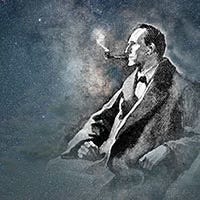
“Damn it, Holmes, at least look at me!”
Holmes complied, though he managed to convey the impression that even asking him to rotate his eyeballs in their orbits was an unreasonable demand.
I had seen him in such moods before. Often he had given himself a hollow, transitory, stimulus with cocaine, his ‘seven per cent solution’, but here, I had gathered, only the most innocuous of narcotics were available without close medical supervision.
Through a sickening sense of déja vu I noted that he had not sunk into his near-comatose state before taking one decisive action. The last time I had passed through Door 14 on Corridor 9 I had found myself—apparently—on board a spacefaring vessel. Now, behind that same door, I had once again entered the replica of 221B Baker Street. Either Holmes had worked out for himself how to operate whatever generated the simulacrum, or he had prevailed on someone else to do it for him. Someone, or something.
Beyond deigning to turn his gaze in my direction, Holmes had barely acknowledged my presence. Perhaps, I thought, a direct question might force a response. “Just how long do you propose to remain like this?”
He did react, though only by languidly lifting one thin hand a few inches. I saw with dismay that his short-barrelled Webley .450 revolver lay in his lap, a replica quite as convincing as the antimacassars, or the aspidistras which Mrs Hudson was had long been wont to infiltrate into the room when Holmes and I were away for a few days.
What of Mrs Hudson? Could the machinery which replicated the Baker Street sitting room so completely produce a replica of our housekeeper too?
That was a thought I had no wish to dwell on. I looked again at the squat dark firearm resting between his hands.
He caught the direction of my gaze, and finally stirred himself to speak. “Fear not, Watson. I have already established that the weapon is inoperable. It would appear that the rules of this simulacrum prohibit it.”
“You didn’t…?”
His lip curled minutely, the merest suggestion of a smile. “No, my dear fellow. I may have had it in mind to add some embellishment…” He waved the gun in the direction of the ‘VR’ drilled into the wall. “Perhaps an ‘RIP’. But even that seems to be proscribed.”
I pulled my armchair closer, facing him. It felt too near to the merrily blazing fire, but the heat was strangely mild. I wondered if it was actually consuming any of the ‘coal’.
“Holmes,” said I. “You know I hate seeing you like this. What’s brought it on this time?”
He waved the revolver again. I flinched instinctively, despite his assurance that it was inert. “The good Inspector summoned us into this existence to solve a case. I—we—have solved it. What, then, are we here for?”
“There will be other cases.”
“Will there, Watson? Will there? You know this was the first homicide in the eight years of this colony’s existence?” He aimed the gun, as if he expected it to work, pulled the trigger. There was nothing but a feeble click. With a disgusted snort, he tossed it aside. Missing the hearthrug, it skittered across the linoleum, fetching with a thump against the skirting. If it was not real, I wondered, how could it possess palpable mass?
Holmes resumed. “As you say, lethargy has descended before, when no case worthy of my attention presented itself. Such hiatuses could last a month or more… and that, Watson, in a city of five million. A city, moreover, which housed the likes of Moriarty and Colonel Moran. Here we are in a community, not of five million, but, I believe, barely fifteen hundred. Logic suggests that the incidence of crime—challenging or trivial—would be proportionately lower; five thousand times lower, in fact. Simple arithmetic alone would seem to consign me to almost perpetual idleness… You know that Inspector Francis is a policeman—but I should not say ‘man’; a police officer—only on an occasional basis, after the manner of lifeboatmen or volunteer firemen. He—ve—told me that in six years’ service no previous case has demanded more than a few hours of veir time.”
“I presume, then, ve has another, more regular, occupation.”
“Indeed so.”
“Then why should you not divide your time similarly? There must be many challenges to engage such an able mind as yours.”
“Watson,” he sighed, “I took my first amateur case as an undergraduate, not yet twenty years of age. I knew from then on that the art and science of detection were my true, my only, calling. In twenty-seven years I have never wavered from that vocation. Am I to be expected, long past the midpoint of my threescore and ten, to throw it over and begin anew?”
“Holmes!” I almost barked in my frustration. “You are, with the possible exception of your own brother, the most brilliant man I have ever encountered, and yet—”
“—Really?” he broke in. “You do not rank Moriarty as my equal? You flatter me, Watson.”
“You defeated Moriarty.”
“I did, but thanks to my proficiency in baritsu, rather than any intellectual superiority. Indeed, I might argue that his ability to track us all the way to Meiringen, despite all our extraordinary measures, suggests that he had the better of me.”
“By thunder, Holmes, you are as infuriating in this new world as you were in the old! But have it your way. There was one man among the five million inhabitants of London who was—perhaps—your equal. To be one of two among so many is still extraordinary… exceptional.”
“And your point, Doctor, is…?”
“My point—as I think you know, could you but admit it to yourself—is that you are among the most brilliant of men, yet you still sometimes contrive to be quite astoundingly stupid.”
For a moment I feared I had said too much. His stare seemed as cold as I had ever seen it. But then he gave a short laugh. “Very well, Doctor. Explain it to me.”
“Holmes, we did not ask to be brought into being in this place, this time, yet here we are. What choices do we now have? I see but two. You can terminate your own existence, or you can find a way to make something of it. Sitting here moping is no third option, even if you could remain indefinitely—which you can’t. You may have been able to fester like this for weeks on end in the past, but this is not Number 221B. There is no Mrs Hudson to pander to your whims. Others will require the use of this… facility.”
“Perhaps so. In point of fact, however, there is a third possibility; one which you appear to have overlooked.”
If you’ve enjoyed this chapter and you’d like to show appreciation without becoming a paid subscriber, you could…