
A Study in Starlight—Chapter Seventeen
Continuing this serialised novel, in which Holmes and Watson find themselves very far indeed from Victorian/Edwardian London

Watson
“I was a key tech on the Incarnation programme almost from the beginning,” said Robin. “And even before that, during my training, I’d started wondering… You know, Incarnation normally means replicating the complete bioprofile of a living person. And that’s a lot of data, yottabytes. A hundred trillion cells in the average human body, a hundred trillion atoms in each cell; ten to the power twenty-eight atoms.” Ve shrugged. “Your genome’s less than a gigabyte, which is why cloning is way more trivial than compiling. But cloning doesn’t recreate an adult, it creates a zygote. It then takes twenty years to produce an adult, and since you can never completely replicate nurture, the end result isn’t the same person anyway.”
I looked at Holmes, sitting in his compiled Victorian clothes, listening attentively. Brilliant as he undoubtedly was, how far could he follow what Robin was saying? Eight years ago, I had known considerably more than he about the inner workings of the human body, and eight years ago I would have understood very little.
Well, I thought, if he wants to know, he can ask.
Robin tasted veir drink and pushed veir hair back. “We’d all talked about it, in training. They’d set us an essay under our ethics module: basically if you could, should you?, but of course it starts you thinking: could you? And: Has anyone tried? And that thought stayed with me.
“Then I signed up and got deepscanned and this-I woke up here. I had that memory—and now I was living in a world where every single one of us was an Incarnate. I’ve come to think that… you know, you might be exactly the same person, down to your fingerprints, your microbiome, your every last memory, but as soon as you come to consciousness as an Incarnate… I think, right from that moment, it changes you. It’s a shift of perspective. A different frame of reference. You might have the same systems but they’re working with new data.”
Ve sipped veir drink again: a compiled claret. There wasn’t a vast choice of wine, but all of it was good. There would have been very little point, all things considered, in skimping on the cost of a few bottles for scanning. “Anyway, I think my perspective changed. The idea of compiling someone from scratch had never been more than a tantalising thought-experiment before. Now… well, I guess it became a bit of an obsession. And of course I had access to a system that was easily capable of handling yottabytes, did it every time we loaded another datapearl and… well, you know. Any QuasI can juggle yottabytes and hellabytes while standing on one leg and singing every aria from Adebayo’s operas simultaneously—and they’d given us one that could run Luna. Future-proofing, I guess. Asking it to model a compilation wouldn’t even begin to stretch it. I could have a clear conscience about that, at least.”
Robin shook veir hair back, looked at Holmes. “I’m sorry, Mr Holmes. Is this too much detail, or not enough? Is this what you wanted?”
Holmes gave vem a brief smile. It wasn’t much, but he’d never been lavish with his smiles. “I cannot pretend to grasp all the details, but I think I see the broader picture. Might I, however, ask one question?”
“Of course.”
“I gather that the literary exploits of Holmes—and Watson—extend beyond 1902, but you chose to… how shall I say…? extract us at that point. I am bound to wonder why.”
“That’s a good question,” said Robin. “I’m not sure I can give you a totally rational answer. There are only a few stories set after 1902, and… well, I don’t fund them quite so compelling, so partly it’s just my personal taste. But also I thought if we were going to Incarnate Sherlock Holmes, we should see him—you—full of experience but still in your prime. If we’d gone all the way up to His Last Bow you’d both have been twelve years older.”
Holmes smiled. “Then I must thank you.”
Mary leaned close, addressed me privately. “Dory for me. I always liked bein’ older’n you.”
“Pray continue.,” said Holmes. “This is fascinating.”
Robin beamed, and I was reminded again that Holmes had been a hero-figure for vem; and even though this Holmes was in many ways veir own creation, the admiration remained. “Thank you. You must have worked out I’m not a real cop. Perhaps it was an oversight, but nobody on our complement had law enforcement training. The Spacers can enforce Service discipline, but as soon as the Triumvirate was formed they agreed there should be some civilian enforcement too. I guess I volunteered because of my amateur interest.”
I glanced at Mary. It had been a few weeks before she’d told me she wasn’t just an operations officer, she was head of the department; weeks more before she confirmed she was one of the Triumvirate. Perhaps she’d assumed I could work it out for myself, but I’d still been spending most of my time feeling like a fish out of water—a feeling which occasionally bedevilled me even now.
The Triumvirate originated because there were three Incarnates with the rank of Commander (and none above). The protocols they’d inherited dictated that the officer with the longest experience at that rank should assume overall command, but Kenji Masuda, who held that distinction, felt that imposing a quasi-military structure on a population that was sixty per cent civilian was likely to lead to tension. My impression was that, even among the Spacers specifically, discipline was more often by consensus than command. And on wider matters, though the Triumvirate sat together on the Council, they didn’t invariably speak or vote as one.
Robin took a little more wine and resumed. “Even with the QuasI doing the modelling, it took nearly six years. That’s mostly because I didn’t have that much time to devote to the project. Between running the compilers and the occasional police work, I was lucky if I could manage three hours a week.
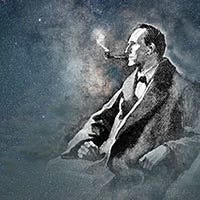
“It wasn’t the physical side that was difficult. We had the text, which doesn’t actually say masses about Holmes’s physical appearance, and even less about Watson’s; and we had a selection of the original Paget illustrations. We know Arthur Conan Doyle gave them his seal of approval, but occasionally they seem to be at odds with the text. In those cases, the text is always paramount.” I shifted uneasily and Mary gave my hand a discreet squeeze. She well knew—she grokked—that mention of Doyle, of our fictional origins, still made me uncomfortable. Eight years on, I’d managed to put it largely out of my mind, until now.
“Still,” continued Robin, “We didn’t have much to go on. We took what we could, stirred in the Paget engravings, but there’s still a lot that we had to… extrapolate.”
I had heard this before, and it hadn’t pleased me then; but Mary had been at pains to assure me that whatever cocktail of influences had determined my physical nature, she was happy enough with the end result. Nor were her reassurances confined to the verbal…
To Holmes, however, all this was new, unless there had been some private conversation between him and Robin of which I knew nothing. I thought this unlikely, because if there had been Robin would hardly need to relate the whole story now. I wondered what Holmes was thinking, but he was in his most sphinx-like guise, eyes half-closed. Some might have assumed he was drowsing, but I knew he could observe far more through nearly-shuttered lids than most people would with eyes wide open. I had no doubt that his attention was entirely focused on Robin and his stillness merely reflected his belief that extraneous movement was a waste of energy. I had seen meditating sādhus in India who fidgeted more than Holmes.
This preternatural immobility may have been an asset to him as a detective, but it was frustrating for anyone who wished to divine the tenor of his thoughts. There was simply no way to tell how he felt. It did not mean, I reminded myself, that he was feeling nothing.
Robin moved on. “In some ways character and personality were easier, because we had a lot more to work with. Taking all the novels and stories, up to 1902, gives us well over six hundred thousand words, and most of those tell us something, directly or indirectly, about the character of one or both men. But if we had more material to work with, it also had a lot more work to do. There’s simply no way it would have been possible without the QuasI to do the heavy lifting… and it still took us six years.
“Along the way, I’m sure our QuasI significantly extended its own theory of mind—which is probably good news for every one of us, on the Orbiter and on the mainland. I’ve talked to Dr Merhawi about this, maybe one day writing a paper together. Suggesting QuasIs need to read more novels… In fact…” Ve turned toward me, hair falling across one eye. “Perhaps Dr Watson would be interested too? I think you must have a unique perspective.”
“If you think I would have something to contribute… Would you consider asking Holmes as well?”
“Of course, but… well, you’ve had eight years experience of Incarnate existence. “
“Whereas I have only a few days on which to reflect,” said Holmes.
“Yes,” said I, “But wouldn’t it be valuable to have both perspectives? The one who’s, in effect, freshly vived, still coming to terms with it all, as well as the one who’s lived with it for years; who barely remembers, most of the time, how unusual his creation actually was?”
“Of course,” said Robin. “I know, Mr Holmes, you’re thinking of leaving us when the Rangitīkei goes… d’you think you could find some time before then to talk with me, and with Doctor Merhawi? If we can find a time that suits us all.”
Holmes gave a thin smile. “I am at your disposal, Inspector. With the one proviso, of course, that both you and I might be otherwise engaged if an interesting criminal case should arise.”
That might have been meant as a joke, I thought. It was often hard to tell, with Holmes. It had taken me years to assure myself that he did possess a sense of humour, albeit one dryer than the surface of Mars.
Robin, who appreciated the unlikeliness of that eventuality, smiled. “Thank you. I’ll speak to Doctor Merhawi, see if we can come up with a time.” Ve pushed veir hair back again. Though nearly always braided or coiled up, it was stubbornly given to escaping its bonds. “On the subject of crime, I said before I’m not a real cop.”
“I reck you’re bein unfair on yourself,” said Aurel, who’d been silently attentive. “You can be real ‘thout bein full-time.”
Robin gave vem a warm smile. I don’t know exactly what’s going on between those two, thought I, but there’s certainly something. “I’m part-time, and most of my training’s come from books… I don’t just mean the Sherlock Holmes canon,” ve added with a sly little grin. Having pegged vem as a young man at first, I was now more inclined to see vem as a woman. What I still found hard was to truly see vem as neither. I’d said to vem once, a propos of just this, ’If I disappoint you, Robin, I can but plead that you made me too thoroughly Victorian, and thus have only yourself to blame.’
“I’m a compiler tech with a sideline in police work,” ve said now. “And Inspector is very much a courtesy title. Which might be why the Council agreed that if there ever was a murder, they’d let me implement my crazy plan. I guess they reckoned I’d need all the help I could get.”
Holmes stirred in his seat. “As I’ve said before, Inspector, I have no doubt you would have apprehended the miscreants in the Hental Shemza case. I am happy to accept credit for helping you bring the matter to a timely conclusion, but no more than that. After all, as I’ve said to Watson on numerous occasions, you know my methods, all you have to do is apply them. And it’s clear that you are thoroughly cognisant of my methods.”
“Thank you, Mr Holmes. So the credit still belongs to you, just indirectly.” Holmes waved one thin hand. “There’s another explanation. Maybe the Council just got sick of me applying for clearance. Fair enough, it was a bit of an obsession.” More than a bit, I thought, as would be apparent to anyone who’d been listening.
Mary sat up a little. “In case anyone dun’t know, I’m on the Council. And I was there that day. You can say ‘obsession’, Robin, but don’t assume we were sick of you.”
If you’ve enjoyed this chapter and you’d like to show appreciation without becoming a paid subscriber, you could always…