
A Study in Starlight—Chapter Seven
Continuing this serialised novel, in which Holmes and Watson find themselves very far indeed from Victorian/Edwardian London.

Watson
“What third possibility?”
“You know my methods, Watson.” How many times had I heard him say that? “Surely you can deduce the answer.”
After a moment, I was equal to the challenge. “You mean… what did Mary call it? Coldsleep.”
“In the vernacular, yes… More formally, ‘cryogenic suspension’.”
“But she said it was rejected because it was too risky. And why would you do that anyway?”
“Which should I address first? The matter of risk, or my reasons for entertaining this option?” He did not wait for an answer. “As to risk, my enquiries inform me, it is not that coldsleep is inherently hazardous, rather that relying on compilers is exceptionally safe. Indeed, in some analyses, the risk to life is deemed to be zero, because each individual’s original remains on Earth, safe and well. Whilst, in your case and mine, we had no prior corporeal existence that could have been jeopardised.”
He let me absorb that before adding, “Compiling is also preferred because it allows the interstellar vessel to be much smaller and lighter. Alternatively a vessel of the same size can carry far more useful matériel: payload, as young Francis calls it.”
“Very well, Holmes, I understand now. I don’t need every last detail.”
“Watson, Watson, how often have our cases turned upon some seemingly insignificant detail? But no matter. You had a second question: why?”
He kept me waiting while he lit his pipe. “This really has no flavour,” said he when it was drawing. “I am led to believe that taste and smell are the hardest senses to satisfy in these sim—”
“Damn it, Holmes, get to the point!”
“As you wish. The point, as you call it, is this: in coldsleep I am spared all of the ennui attendant upon long periods of idleness. I’m spared the torment of uselessness. I would leave instructions to have myself revived should there be a murder, or other sufficiently challenging case. Preferably one with more meat on its bones than this matter of Hental Shemza. It occurs to me that you and Inspector Francis would be well qualified to determine whether any given occasion justified my revival.”
“You assume a great deal, Holmes,” said I stiffly.
“I assume nothing except that I might make such a request. But there is another contingency which would also warrant revival.”
“What?” I knew I sounded brusque, but my temper was stretched.
“Again, Watson, you have heard this, if you can but put the pieces together.”
“You mean… this so-called Fast Ship? This as yet entirely hypothetical Fast Ship?”
“Just so.”
“Let me be sure I understand. It is your notion that at some point—some entirely unknown point—in the future, when and if such a vessel reaches here, that you can awaken—and then what? The great detective makes a triumphant return to Earth, to solve the most enigmatic crimes of the twenty-third century just as he did for the nineteenth?”
“You are trying to bait me, Watson,” said he, smiling, “But I refuse the lure. What you describe in attempted parody is almost exactly what I envisage in fact. I rebut only the word ‘triumphant’. Triumph, if any, will come only when I have earned it.”
“As I’ve said already, you are among the most brilliant of men, yet every now and then you display an obtuseness which makes me feel that I am the intellectual Titan. Have you never considered, even for a moment, that there might be other outlets for your undoubted talents? Here, on this new frontier? What can a brilliant analytical mind achieve… or should I say, what can it not achieve? Surely the skills of the detective can be applied to matters other than crime?”
He sighed. “A new frontier, as you say. But one in which all my years of study in chemistry, for example, amount to almost nothing. What use being able to distinguish a hundred and forty varieties of tobacco ash in a world where no one smokes? What use is intimate knowledge of the stratigraphy of the London basin on a world whose geology is radically different?”
“You’ve never shied away from new learning, Holmes.”
“Everything I have learned since childhood has been built onto solid foundations. Here, the foundations themselves are no longer relevant.”
“You seemed perfectly fine while we were investigating the Shemza murder.”
He shrugged. “I immersed myself in it while it lasted. And I dare say I was able to aid Inspector Francis with a few small insights… but I did not solve the case. The suspects revealed themselves by attacking the drone, and then by opening fire on us—on you, in fact. I may have helped speed the enquiry, but I am sure you will agree young Francis would have tracked them down soon enough, with or without my help.”
“Ve doesn’t think so.”
“Ve underestimates veir own abilities. Would that more members of the constabulary had exhibited similar modesty.” He sighed. “No, Watson, you do not persuade me. In this environment I am a fish out of water, and the chances of any case presenting itself—any case to which I might make a unique contribution—are slender indeed.”
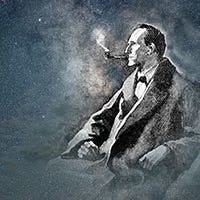
He lifted his head, caught my eyes. “But you, Watson; you seem to have acclimatised yourself with remarkable facility. Dare I suggest that this owes something to the estimable Mary Mall’stang?”
“It does, beyond doubt.”
“I am happy for you… but I am also surprised. I never thought of you as having a taste for … darker meat.”
“Damn you, Holmes, you go too far!” He looked at me as if he had no idea what had upset me. “How dare you use such a word in allusion to the woman I… to a woman I admire greatly.”
“I beg your pardon.”
I was not certain how sincere the apology was, but gave him the benefit of the doubt. “You’re nothing if not observant, Holmes; you cannot have failed to notice that racial demarcation has no standing here. The sole distinction she recognises is between Earther and Martian, and her fellow-Martians can be as dark as she, or as blond as any Swede.”
“Forgive me, my dear fellow, for my poor choice of words. You will, however, agree that she is quite different from your late wife—and from any other woman I’ve ever seen you admire?”
“I’ve had the same thought myself,” I admitted. “Yes, she’s different in many ways, but the colour of her skin is quite the least of them.”
“In any case, it does seem as if you have… fallen on your feet.”
Something in his tone… “Bless my soul, Holmes, I do believe you’re jealous.”
“Come, Watson, you cannot criticise my choice of words and then misuse them yourself. Jealous is when you resent others coveting what is yours: envious is when you are the one who covets. You might accuse me of envy; I might deny it but the suggestion is not syntactically absurd. There is no sense in an accusation of jealousy.”
I considered. Not for a moment did I imagine that he ‘coveted’ Mary Syrtis Mall’stang any more than he had ever ‘coveted’ my wife, or any other woman, save possibly Irene Adler. However… “I beg to differ, Holmes. I fully grasp the distinction, and I stand by my earlier remark. You are jealous; jealous of me.”
He regarded me for the space of several breaths. I had no notion how he might respond. Finally he stirred. “Damn you for an honest man, Watson. And, at moments, a perceptive one.” He drew a deeper breath, let it out in a long sigh. “Honesty calls for honesty, and so I say that you are right: I have detected in myself some resentment over your… friendship with the remarkable Miss Mall’stang.”
I did not correct ‘Miss’. “Thank you, Holmes.”
He sat up slightly, torso approaching forty-five degrees. “As you well know, I am not a man who makes friends easily. Over the past twenty years—or is it, even, a little more…? We met in 1881, and I suppose the year now—well, not now, but…”
“I believe the date you mean is 1902.”
“Twenty-one years, then. Throughout that time you have been my truest friend and confidant. I’m sure I haven’t always shown sufficient appreciation.” That was an understatement, but I let it pass. My friendship and loyalty had been amply rewarded, though rarely through overt expressions of gratitude, still less anything that might be termed affection. “I should like to do better; I mean to do better. If your new friendship brings you happiness, or gives you an anchor in this strange new world… then I rejoice for you, and if I can further your happiness in any way, I shall be glad to do so.”
“Thank you, Holmes. Very decent of you.”
He mumbled something that might have been least I can do. Then his gaze sharpened. “I said ‘friendship’—twice, in fact—but am I right in suspecting it might be something more? More than purely, ah, Platonick?”
I felt heat in my cheeks, and knew that he had seen it. I had not grown florid with advancing years, but a tendency to blushing—which one might expect to be more pronounced in youth—seemed to have intensified. I wondered if this, or any other shortcomings I might detect in my present self, might conveniently be blamed on the compilers.
And then I thought; where else could I possibly lay such blame?
Holmes smiled, not unkindly. “Hardly a protracted courtship. What has it been? Not seventy-two hours since you first awakened in this new milieu. Tell me, Watson, if the question is not impertinent, do you see a future in it?”
“I can hardly say… but I dare to hope that perhaps…”
“So soon?”
“I knew within twenty-four hours of meeting Mary Morstan that I wished to marry her.”
“And this Mary?”
“People here barely even know what ‘marriage’ is. Unless, like Inspector Francis, they are students of history. They speak only of partnership. I suppose it amounts to the same thing, more or less, but I confess I am not sure I will be entirely easy in my own mind without some form of ceremony, some exchange of vows.”
Holmes smiled from the depths of the armchair. “I have masqueraded as a priest on at least a dozen occasions. Of various denominations… I should have no objection to assuming such a guise once more, if you would welcome it. And the lady too, of course.”
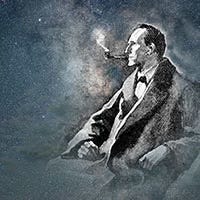
Though any—hypothetical—ceremony would not require a priest, I had taken real encouragement from his offer. It was a handsome gesture by any measure but, more than that, it suggested he might be edging towards an acceptance—even an embrace—of this strange life into which we had been precipitated.
I glanced at the clock, then remembered that everything I could see, except Holmes himself, was a simulacrum. There was no obvious reason why the clock should display the correct time—though, equally, no obvious reason why it should not. I recalled then that the ‘Agent’ implanted behind my right ear could give me the time with perfect accuracy; a trivial task for it.
“I shall have to be on my way soon,” said I.
“An appointment with your… may I say your betrothed?”
I left that question to one side. “Not Mary, no. I shall be calling on Doctor Merhawi…”
He nodded. “So you are contemplating resuming your medical practice?”
“Shall we say I am exploring the feasibility of doing so. I must satisfy myself, and Doctor Merhawi of course, that it is even conceivable for a doctor trained three hundred years ago to adapt himself to the knowledge and practice of today. It will surely be a lengthy and probably an arduous progress.”
“But it would give you some…” His voice trailed off. It was rare for him to sound so uncertain, but I thought the word he had been about to utter was ‘purpose’.
“I am a doctor,” said I, “As you are a detective. But if it really seems impossible for me to catch up with three centuries of change, then I suppose I must look for something else to do.” I refrained from saying anything more about the unpalatability of a life of unproductive idleness. Holmes had already made his feelings on that subject abundantly clear.
Or so I thought; in any case, I could not pursue the matter. His active mind had darted off on another trajectory. “In the final analysis, Watson, are we even real?”
I thought of Mary’s two tests. My mind balked at explaining those—especially the second. I had another riposte: “What are we if we aren’t real?”
He did not answer directly. He waved at the sofa, where his violin-case rested. “When first I entered this room, I thought I might play a few airs. Finding my efforts unsatisfying, I dutifully restored my precious Stradivari to its case for safe-keeping… yet as soon as we leave this chamber the instrument will cease to exist, just as will the sofa and the fireplace and everything else. That’s true, is it not, Watson?”
“It is, but everything is memorised so it can be recreated next time. You can stipulate that the room be rendered precisely as you left it, so perhaps there is some point to stowing the violin as you would like to find it.”
“Perhaps,” said he. “But I conducted a small experiment earlier. I attempted to take the violin down the stairs and out into the street—if one may even call it a street. I suppose you can guess what happened.”
“It would have ceased to exist, as my coat and hat did the first time we left this room.”
“Indeed. A most peculiar sensation. I have seen things dissolve, fall apart, crumble into dust—but never anything like this. And it reformed as soon as I turned around and stepped back within. That was, if anything, even more… disconcerting.”
“I’m sure… but we know that this room and everything in it is a simulacrum. No doubt it’s in the nature of the thing.”
“This room and everything in it,” he repeated slowly, investing the words with significance. “Does that include the two of us?”
“Did you dissolve when the violin did? Of course you did not. It is a simulacrum; we are real.”
“But are we? Are we Watson? Even before such notions as compiling were conceived, before simulacra such as this were possible, philosophers had often contested the truth of so-called reality.”
“You know I’m a plain kind of fellow. This kind of philosophising goes right over my head.” I rapped hard on the tabletop. “A moment’s pain in my knuckles; that’s real enough for me.”
“I think, therefore I am?” said Holmes with a smile.
“For you, maybe,” I said. “For me it’s more like I feel therefore I am.”
He gave a nod, ruminating. “I too rarely concern myself with high-flown philosophy—or should I say, I have few memories of doing so? But that’s the rub, is it not? All we are is memories.”
“I said the same to Mary just the other day. Do you know how she replied?”
Holmes laughed briefly. “If I could deduce that I should truly be an extraordinary detective.”
“Ain’t that all anyone has? That was her answer.”
He considered a moment. “Perhaps so… but where do those memories come from? Hers, from a real life. In another time, another world, but real. Ours, though, yours and mine… whence do those memories derive?” He waited a moment, went on when I did not answer. “I heard some more from Inspector Francis—when you, I suppose, were with your Mary. How our files were assembled. How the text was paramount—that was the word ve used. You know, of course, what text ve was referring to.”
“The novels and short stories.”
“Indeed. Recall the titles of the collections of short stories: The Adventures of Sherlock Holmes, The Memoirs of Sherlock Holmes, The Return of Sherlock Holmes, The Casebook of Sherlock Holmes. Observe the common factor: Sherlock Holmes. And what is Sherlock Holmes? The great detective. What else is he? What other life does he have? What is his past?” His eyes almost bored into me. “We learn more about the antecedents of John Watson in the first pages of A Study in Scarlet than we ever do about those of Sherlock Holmes. Any sense I may have of my birth, my family, my schooling, is a confection, a garnish added by Robin Francis and the… automaton ve calls the QuasI. But…” He shrugged again. “Maybe it does not matter. Whether it’s drawn from the paramount text, or the Inspector’s fancy, or somewhere else, I am a counterfeit.”
“Holmes!”
“Four novels and over fifty short stories, I believe. To you and me, they are of course the work of Doctor John Watson, but to everyone else, to history, they are the creation of one Arthur Conan Doyle.” He gave one of this thin, mirthless smiles. “By all historical accounts, it seems, this Doyle was a prolific and very well-known author. If not quite equal to Mr Dickens, certainly in the next rank. And yet, Watson, you and I; we know the works of Dickens, of course, of Eliot, Gaskell, Trollope, and many more; but had you ever, until these last days, heard of Arthur Conan Doyle?”
I had to admit I had not.
“It’s almost amusing,” said he. “In other circumstances I’m sure I would indeed find it droll. Doyle, I suppose, strives for veracity, makes his London as true as he can to the one he knows in life, and yet in his London he himself has been entirely erased from existence.”
“I suppose that’s true,” said I uncomfortably; uncomfortable not least because in my memories I had written those novels and stories. But that was precisely the point Holmes was driving at.
“And have you heard of a fellow called Sidney Paget?”
“Of course. He was the illustrator for The Strand Magazine.”
“Indeed. And in my memories I am both irritated and relieved that his version of me bears only the most superficial resemblance to myself.”
That he was irritated, I could understand, and in any case I had memories of several occasions on which he had expressed displeasure with the artist’s depiction. The other, however, puzzled me. “Relieved?”
“Relieved, because a more accurate depiction would have made it harder for me to maintain any meaningful anonymity. Being too readily recognisable could be a great hindrance to my work, and it was not always convenient to assume a disguise.
“Consider, however, the question which faced Robin Francis and his collaborator, the thinking machine. In creating, or recreating—choose your word carefully—Holmes and Watson, how did they decide on their physical characteristics? Robin tells me this was one of the easier aspects, but then the full process of preparation took years. The text, of course, is always paramount, but it hardly goes into exhaustive detail about Holmes’s physical appearance, and there is even less regarding Doctor Watson’s. Text apart, their main source, for better or worse, was Paget. And the rest, in Robin’s word, was extrapolation.
“Still, the fact remains, Watson. Look in the mirror, and what you see is to a high degree the creation of Sidney Paget.”
I did not stand, to avail myself of the mirror over the mantel. I did not like the taste of the idea he had just planted. I supposed I could hardly avoid mirrors entirely, but there must be ways in which I could modify my appearance, and doing so might also help me fit in better to this new world. I thought that Mary might have a good deal to say on this, and wished I had time to consult with her immediately.
Time…
“Holmes,” said I. “I really must go. Just promise me one thing.” I thought again of the revolver, of the impulse that might have possessed him had the thing been functional. “Promise me you won’t do anything rash.”
“Really, Watson,” said he with the nearest thing to a true smile he had managed all morning. “When have you ever known me act without deliberation?”
If you’ve enjoyed this chapter and you’d like to show appreciation without becoming a paid subscriber, you could…